• “We Had it All” — Ray Hudson and "Once in a Lifetime"

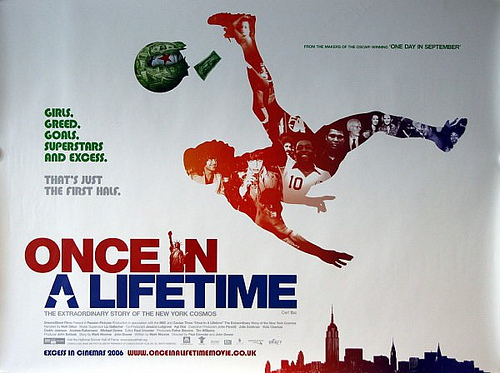
    once-in-a-lifetimeProfessional soccer in the U.S.A. took center stage at FSF on February 24. Ray Hudson dubbed us the “football think-tank” and answered questions in the inimitable style he brings to broadcasting a Clásico on GolTV. Using the documentary film Once in a Lifetime: The Extraordinary Story of the New York Cosmos, FSF discussed Cosmos and the NASL, as well as the representation and construction of history on film. “We had it all, man!” said Hudson looking back fondly to his playing days with the Ft. Lauderdale Strikers.

    Steven Apostolov, David Kilpatrick, Ben Healy, Melissa Forbis, Corry Cropper, Peter Alegi, Ben Dettmar, Hikabwa Chipande, and Alex Galarza participated in the session.

    The audio recording of the conversation is here. (For educational/personal use only.)

    One more thing: our next online session is on March 16, 2pm EST. Author David Goldblatt will be at Michigan State University in East Lansing to discuss the second half of his book, The Ball is Round. FSF’s discussion of the first installment is here.

  • FSF February 24 2pm – Once in a Lifetime

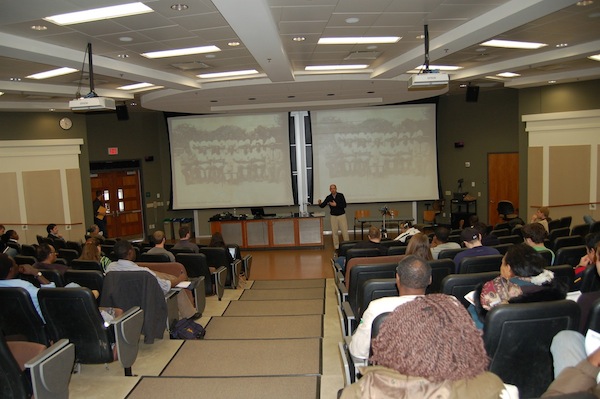
    Our next session is less than a month away. Ray Hudson will be joining us to discuss the film Once in a Lifetime: The Extraordinary Story of the New York Cosmos. The session will be held on Friday, February 24, at 2pm Eastern Time. The film will be an excellent launching point to discuss not just the Cosmos and NASL, but also the representation and construction of sport history on film.
     
    Clive Toye’s book, A Kick in the Grass, also discusses the history of the NASL and would be worth perusing before the session. I would also remind everyone that we are building a film repository. This project can be a great success with the group’s contributions in the form of annotations and adding titles. As always, please RSVP asap to be included in the Skype conversation.
  • A Fall First XI: Football Scholars Miscellany

    It’s been another few months of abundance for those of us interested in thinking about ways the scholarly might engage with the sporty, so I thought I’d have another go at a ‘First XI’ of miscellaneous themes and links as food for FSF thought.  As always, the intention is not to try to cover everything (I’m particularly sorry that I haven’t yet been able to find much on the upcoming African Cup of Nations; the hosts Equatorial Guinea and Gabon should offer lots of talking points)—nor to focus on the specifically scholarly. Instead, the hope is to draw from a mix of the scholarly and the broader football world to offer perspectives that might be of interest to those thinking about such intersections. And please let me know what I’ve missed through comments or email—the First XI is never necessarily the best eleven; it’s just what’s available on the day…

    1) Conferences; there’s been a bunch. Probably the largest in-person aggregation of FSF members came in the DC area at George Mason’s ‘Sport in the Global South’ conference (abstracts available at the linked page—though not all football specific), graciously hosted by John Nauright and the Academy of International Sport. (more…)

  • FSF Nov. 9: "Soccer in the Classroom" Draws Record Crowd

    “Football/Fútbol/Soccer in the Classroom” drew 17 people, a new record for FSF! It was an extremely productive and fulfilling session.  Peter Alegi, Tom McCabe, Steven Apostolov, Sean Jacobs, Alon Raab, and David Kilpatrick kicked off with brief comments on each of their soccer courses. A vigorous and wide ranging discussion ensued.

    Among the many questions and issues tackled by the collective, were the following: how can we integrate technical and tactical aspects of the game into broader intellectual analysis? Given the huge canvas of “global soccer,” how have instructors dealt with thematic, geographic, and chronological coverage? Which films and popular literary works have worked well and why? What is the state of “football archives”?

    Several individuals spoke of the importance of knowing your audiences and valuing diversity.  Other participants commented on the challenges and rewards of being the first to teach sport-focused courses in their departments and institutions.  After nearly two hours, the session ended with Alon reminding us of what Swami Yogananda once said: “You will be closer to Heaven through football than by the Gita.”

    Audio of the session is available here. (For educational/personal use only.)

    Participants (in random order):

    Graham Stinnett
    Alejandro Gonzalez
  • FSF November – Football in the Classroom

    Please join us for the Football Scholars Forum session on Soccer in the Classroom, Wednesday, November 9, at 2pm Eastern Time. Peter Alegi, Alon Raab, Tom McCabe, Steven Apostolov, and Sean Jacobs will each make 5 minute presentations on their courses to jump start a discussion about syllabi, sources, readings, pedagogy, and how to include a unit/section/lecture on soccer in  humanities or social science courses. We’re using the FSF website to pre-circulate course designs and syllabi, so please send me any syllabi or reading lists you would like to share to: galarza1@msu.edu

    Some questions to spark discussion: (1) How can teaching a course or unit on soccer expand or contribute to disciplinary knowledge? (2) What are the challenges and opportunities of teaching a fútbol class filled with everyone from fantasy soccer geeks to soccer neophytes? (3) How can students apply what they learn in a soccer course outside the classroom?

    As always, please RSVP if you plan on attending via Skype (provide your username). Soccer in the Classroom promises to be one of our most exciting and productive, so don’t miss out.

    In other news, FSF will be included in a poster session at HASTAC 2011, a conference on digital scholarly communication hosted at the University of Michigan in December. We are very excited to share our experiences with FSF at the conference; thanks to everyone who has helped us grow and learn!

  • Klinsmann's USA project: Reform or Revolution?

    The international break generated debate about Jürgen Klinsmann’s short tenure as USA selector and coach. Results of friendlies aside, George Vecsey of the New York Times points out that the German is a proponent of “the revolutionary theory for young players that soccer should be fun” and invites fans to watch the team’s training sessions. Together with Claudio Reyna — the former fantasista turned head of US player development — Klinsmann believes “coaches can teach soccer, but on the field, soccer is not a teachable sport. [ . . .] Athletes must play the game by themselves; they must be creative.”

    Of course, the US soccer system has demonstrated little such creativity so far. In general, its pay-for-play youth system marginalizes or excludes the working class and the poor and almost invariably produces robotic, Anglophile, tactically troglodytic teams. So is Klinsmann’s project reformist or revolutionary?

    Amy Lawrence in The Guardian’s Sports Blog writes that “the great German enthusiast is trying to overhaul football in the US not just the national team.” The post picks up on some of Vecsey’s insights and adds Klinsmann’s criticism of both the short MLS season and the archaic system of using college soccer to form professional players. Readers’ comments on the blog page make for fascinating reading. What do you think about the Klinsi debate?

  • ¡Adelante! Fútbol and Politics in Chile

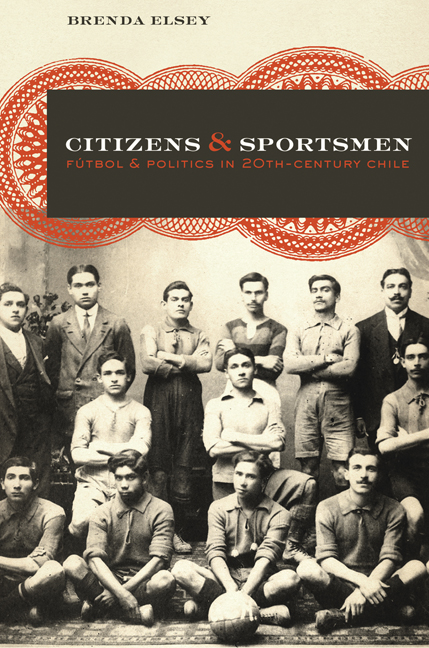
    elseybookIn a vibrant opening to the 2011-12 FSF season, we discussed Brenda Elsey’s book Citizens and Sportsmen.  Brenda made FSF history by being the first author to visit Michigan State University in person, for which she received a stylish FSF t-shirt and a dinner in her honor! Situating her study in the context of Latin American historiography’s concerns with the question of how democratic Chile was before the 1973 coup, Elsey uses football to convincingly argue that the country was strongly democratic before Pinochet’s rise to power.  The group explored topics such as sources and methodology; gender, class and race; the 1962 World Cup; football clubs as conduits for political mobilization; and the secularization of public space. The participants were: Alon Raab, Chris Gaffney, David Kilpatrick, Ingrid Bolivar, Brenda Elsey, Alex Galarza, and Peter Alegi.

    Unfortunately, the audio from the session is flawed, but is nevertheless available here.

    On Thursday (9/22), Brenda gave a campus talk introducing her book on Chilean football and politics. The next day she attended a grad seminar where we discussed her article from the Journal of Social History, “The Independent Republic of Football: The Politics of Neighborhood Clubs in Santiago, Chile, 1948-1960.

    Our next session on Wednesday, November 9th will focus on football in the classroom. Peter Alegi, Tom McCabe, Steven Apostolov, and Alon Raab will lead the discussion. This will be an excellent opportunity to exchange syllabi, sources, reading lists, and teaching perspectives. Our discussion will not necessarily center on soccer-specific courses; if you would like to include a unit/section/lecture on soccer in your humanities or social science course, be sure to join the discussion.

  • Fall 2011 Lineup

    The schedule page has been updated with our new fall schedule, our fourth semester of FSF sessions! On Friday, September 23, at 3pm EDT we will be discussing Brenda Elsey’s Citizens and Sportsmen: Fútbol and Politics in Twentieth-Century Chile. Dr. Elsey will visit Michigan State on September 22-23 to give a public lecture and host a seminar for graduate students.

    On November 9, FSF will host a session on “Soccer in the Classroom.” Peter Alegi, Tom McCabe, Steven Apostolov, and Alon Raab will lead the discussion. This will be an excellent opportunity to exchange syllabi, sources, reading lists, and teaching perspectives. Our discussion will not necessarily center on soccer-specific courses; if you would like to include a unit/section/lecture on soccer in your humanities or social science course, be sure to join the discussion.

  • Women's World Cup Miscellany: A First XI

    Can you be a ‘football scholar’ and not appreciate a World Cup?  Even if you get frustrated by the politics and/or the play, the spectacle of a particular, peculiar version of the modern world on stage always seems to cry for interpretation and engagement.  And, sometimes, ever so briefly, for letting slip the critical lens to simply enjoy a good game of football.

    This 2011 Women’s World Cup, to conclude on Sunday in Frankfurt, has offered up a bevy of both cultural artifacts to deconstruct and the beautiful game to savor.  So it seems like a grand occasion for the next iteration of a FSF First Eleven—an eclectic attempt to highlight works that might be thought/reaction-provoking for scholars, even if not explicitly scholarly.  I’ve gotten a few suggestions from others, and I’m sure I’m missing much other good work, but I make no claims on being comprehensive.  Instead, the hope is to try to help create spaces for exchanging and enriching perspectives related to the game—this time specifically related to the women’s game and with particular emphasis on this World Cup—so please feel free to add, suggest, or critique in the comments or via email [drewguest(at)hotmail.com].  And allow me the immodest liberty of mentioning one of my own modest efforts from a few years back, since it was a collaboration with current US team member Stephanie Cox (the article is based on her senior thesis data from working with me at the University of Portland—a true scholar-athlete!).

    But without further ado, here’s a first eleven: (more…)

css.php